
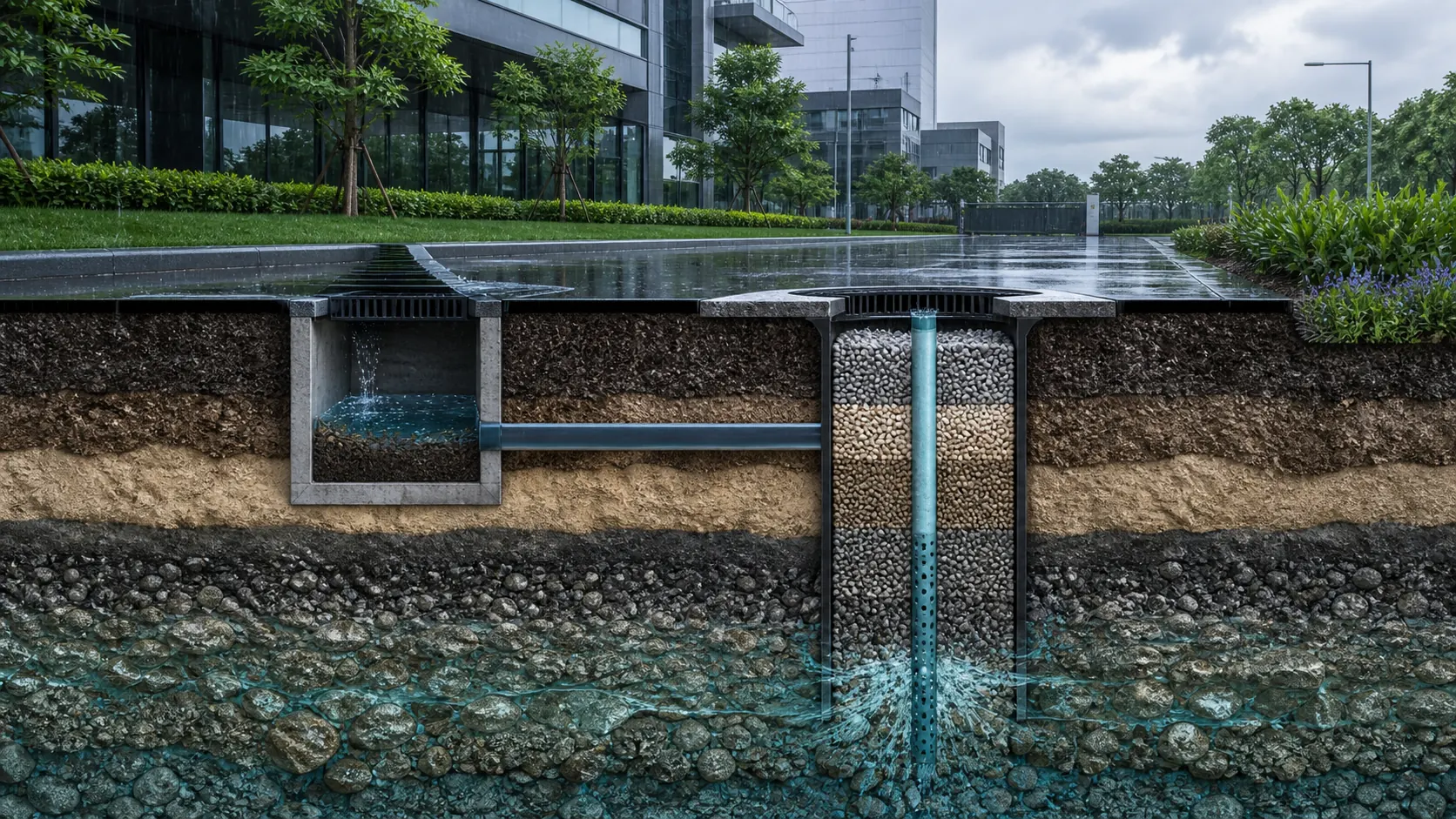
Groundwater recharge is often reduced to a drawing of a pit filled with stones. Effective recharge is more demanding. The source must be suitable, the aquifer must be able to receive water, the structure must match local geology and the system must remain clean through repeated monsoons. A scientifically planned project protects groundwater quality while improving infiltration and reducing uncontrolled runoff.
Define the recharge objective
Clarify whether the project aims to manage rooftop runoff, reduce local waterlogging, augment groundwater, comply with an approval condition or support a wider watershed. The objective determines the study area, monitoring and structure. A campus drainage project differs from a regional aquifer-recharge programme even when both use the same phrase.
Quantify the available source by catchment, rainfall and runoff. Examine storm intensity and overflow routes, not only annual volume. Recharge structures should be part of a safe drainage plan so intense rainfall cannot flood buildings or carry contaminated water into the ground.
Investigate soil, geology and groundwater
Recharge performance depends on the layers below the site. Soil permeability, unsaturated thickness, aquifer type, groundwater level, lithology and nearby wells all influence feasibility. Trial pits, bore logs, infiltration tests, groundwater data and local hydrogeological studies may be needed. A structure copied from another location can be ineffective where clay, hard rock or shallow groundwater behaves differently.
The investigation should estimate available subsurface storage and identify the layer intended to receive recharge. It should also note contamination risks, underground utilities, foundations and required setbacks. If the site is unsuitable, designers should consider storage and reuse, distributed infiltration or off-site watershed interventions instead of forcing a recharge shaft into the plan.
Protect groundwater quality
Only suitable water should enter a recharge system. Clean rooftop runoff is generally preferable to runoff from parking, production, chemical storage or waste-handling areas. Separate contaminated catchments and provide first flush, screening, silt removal and filtration appropriate to the source. Sewage or industrial effluent should never be routed into a rainwater recharge structure.
Test source water where risk exists and follow applicable standards and approval conditions. Silt traps and inspection chambers should be accessible for cleaning. A blocked filter encourages bypassing, while a poorly sealed shaft can become a direct contamination pathway. Quality protection must remain effective after the ceremonial commissioning day.
Select the structure for the site
Recharge pits, trenches, shafts, wells, percolation tanks and check structures serve different conditions. Shallow permeable formations may accept distributed pits or trenches. A deeper permeable layer beneath less permeable material may require a carefully designed shaft or recharge well. Large catchments may need several structures to control flow and simplify maintenance.
Hydraulic capacity should match design inflow without assuming constant infiltration. Filter media, chamber size, pipe levels, overflow and scour protection must be detailed. Existing abandoned borewells should not be casually converted. Structural safety, well construction and water-quality safeguards require competent engineering and site-specific approval where applicable.
Plan overflow and maintenance
Every recharge system has a limit. Provide a visible, erosion-safe overflow to the approved drainage route. Avoid creating backflow into roof drains or low-lying operational areas. Inspection openings, ladders, covers and confined-space controls should support safe maintenance. Vehicle loads and site traffic may also affect chamber design.
Before the monsoon, clean catchments, first-flush devices, silt traps and filter media. After major storms, inspect for standing water, blockage, erosion and settlement. Desilt as required and record the work. Maintenance frequency should reflect the catchment and sediment load, not a generic annual line in a manual.
Measure whether recharge is working
Record rainfall, inflow where practical, water levels and maintenance. Observation wells or piezometers can help track trends when installed and interpreted correctly. Short-term water-level rises alone do not prove long-term aquifer benefit because pumping, rainfall and nearby recharge influence the readings.
Use a baseline and compare multiple seasons. Combine monitoring with photographs, desilting records and structure inspections. For industrial facilities, integrate recharge data with abstraction and reuse metrics to show the complete water balance. Effective recharge is a managed environmental asset: it is investigated, designed, protected, maintained and reviewed throughout its life.
Common reasons recharge systems fail
Structures commonly fail because the catchment remains dirty, silt traps are too small, filters are inaccessible or runoff bypasses the intended inlet. Some projects ignore a shallow water table or place structures in low-permeability soil. Others provide no overflow, causing waterlogging during intense rain. These are design and maintenance failures, not evidence that recharge itself is ineffective.
A pre-monsoon audit should trace water from every catchment to the final structure. Pour or flow tests can reveal disconnected pipes and blocked paths. Inspect filter media, chamber walls, covers, safety arrangements and the receiving formation. Corrective work should be completed before rainfall begins, when defects are easiest to fix safely.
Key takeaways
- Confirm feasibility through site-specific hydrogeology.
- Use clean source water and maintain pretreatment.
- Match the structure to the receiving formation and design flow.
- Provide safe overflow, access and multi-season monitoring.