
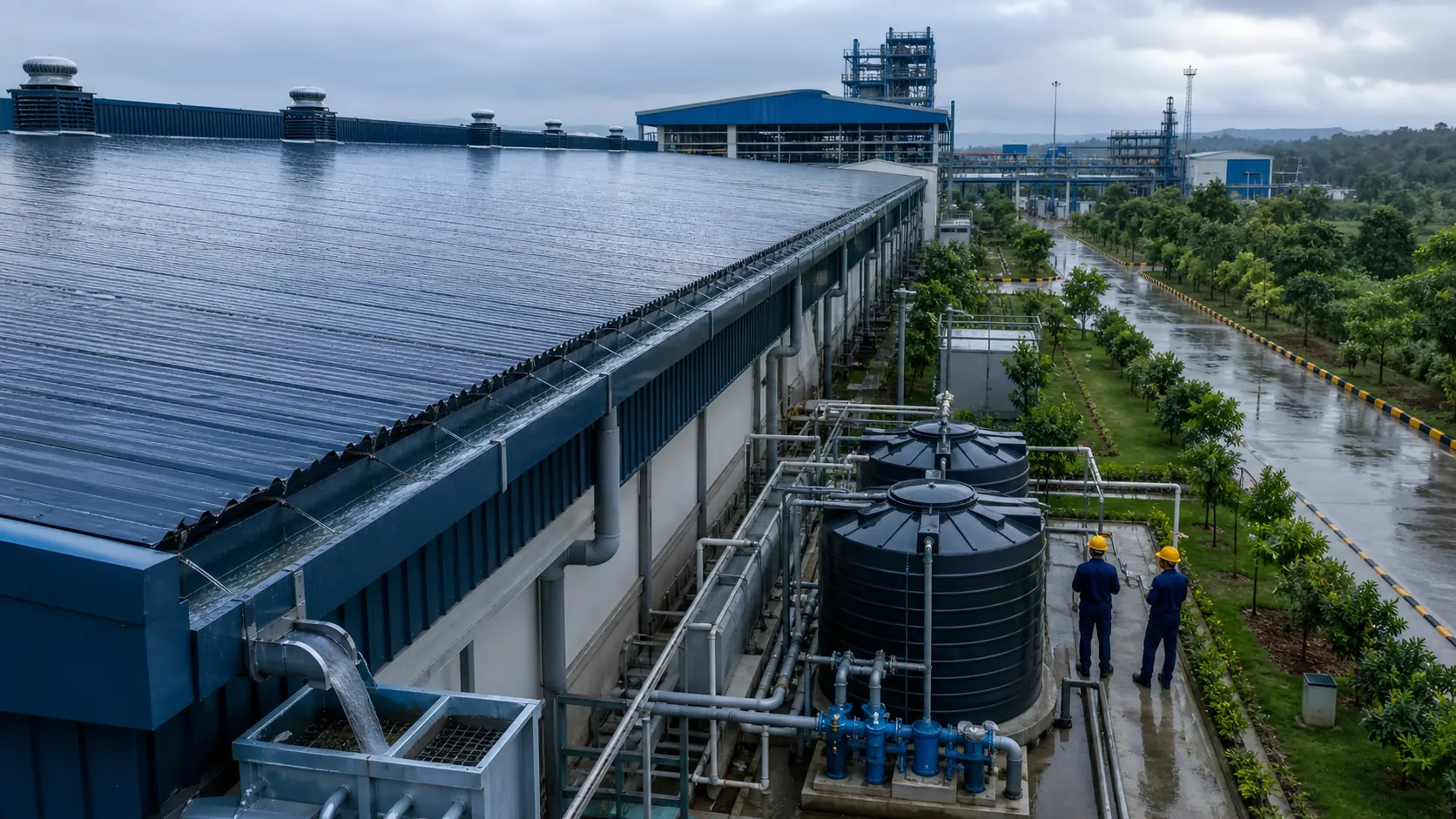
For an industrial facility, rainwater harvesting is more than a conservation feature. A well-designed system can reduce dependence on tankers and freshwater sources, improve monsoon resilience, support groundwater recharge and give sustainability teams measurable results. The strongest projects connect the roof, drainage, filtration, storage, reuse and recharge into one operating system designed around the site's water demand.
Begin with the facility's water balance
The first question is not how large the roof is. It is where water currently comes from, how much the facility uses and which demands can accept harvested water. Review borewell extraction, municipal supply, tanker purchases, process consumption, cooling-tower makeup, washing, landscaping and domestic use. Monthly data reveals demand peaks and the real value of replacing purchased or extracted water.
A site survey should map every usable roof and paved catchment, its material, slope, drainage points and contamination risks. Workshops, chemical-handling zones and traffic areas may require separation or additional treatment. The result should be a water balance that connects available rainfall with safe and useful destinations.
Estimate realistic harvest potential
A preliminary estimate multiplies catchment area by local rainfall and an appropriate runoff coefficient. The coefficient accounts for the portion that can actually be collected from a particular surface. A detailed design also allows for first flush, evaporation, leakage, overflow and rainfall intensity. Annual rainfall alone is not enough because the same total can arrive through many moderate events or a few intense storms.
Designers should therefore examine historical rainfall distribution and peak intensity as well as the annual average. Gutters, downpipes and conveyance channels must carry peak flows without flooding roofs or production areas. The calculation should distinguish theoretical yield from dependable usable yield so business cases are not built on inflated savings.
Choose storage, reuse and recharge together
Storage is valuable when the facility has regular non-potable demand during and after the monsoon. Tank capacity should balance available space, collection potential, demand and the cost of construction. An oversized tank may remain underused, while an undersized tank overflows quickly. Existing fire, raw-water or process tanks may sometimes be integrated after an engineering and quality review.
Recharge can receive overflow or water not required for immediate use. It should never be treated as a convenient disposal route. The number, type and depth of recharge structures must follow soil, geology, groundwater levels, source-water quality and available setback conditions. Many industrial sites achieve better results through a hybrid system that prioritises reuse and directs suitable surplus to scientifically designed recharge structures.
Protect water quality at every stage
A dependable system starts with roof cleaning, drain maintenance and a first-flush arrangement that diverts the initial contaminated runoff. Leaf screens, silt traps and filtration units protect storage and recharge structures from debris and suspended matter. Treatment after storage depends on intended use. Gardening may need basic filtration, while cooling, process or domestic applications require quality targets specific to the equipment and health risk.
Water quality should be tested before a new use is approved. Cross-connections between potable and non-potable lines must be prevented, tanks should be covered and accessible for cleaning, and overflow should discharge safely. For recharge, water must meet applicable quality conditions so that an environmental project does not create an aquifer-contamination risk.
Plan operation, monitoring and maintenance
Rainwater systems often underperform because nobody owns them after commissioning. Assign responsibility for pre-monsoon roof cleaning, filter-media inspection, desilting, valve operation, pump maintenance and post-rain checks. Provide safe access to gutters, chambers and tanks. A simple operating manual should show flow paths, bypasses, cleaning frequency and escalation contacts.
Meters make performance visible. Measure harvested water sent to storage, reused water and, where appropriate, water directed to recharge. Track tanker reduction, freshwater substitution, system uptime and maintenance cost. These figures help facility teams improve operation and give management credible evidence for sustainability and ESG reporting.
Build the project around outcomes
A sound proposal should state what the system is expected to achieve: annual collection, useful substitution, recharge potential, flood-risk reduction or a combination. It should include survey findings, calculations, drawings, treatment logic, bill of quantities, implementation controls and a maintenance plan. Structural, electrical and safety requirements should be coordinated before work starts.
The best time to assess a system is before the monsoon, leaving enough time for design and execution. Existing systems can also be audited for blocked drains, bypassed filters, damaged pipes or unused storage. Whether the project is new or being revived, success means that rain falling on the facility becomes a managed resource rather than uncontrolled runoff.
Key takeaways
- Map demand before sizing infrastructure.
- Use rainfall intensity and realistic losses, not only annual averages.
- Combine reuse, storage and recharge where site conditions support it.
- Measure performance and maintain the system before every monsoon.