
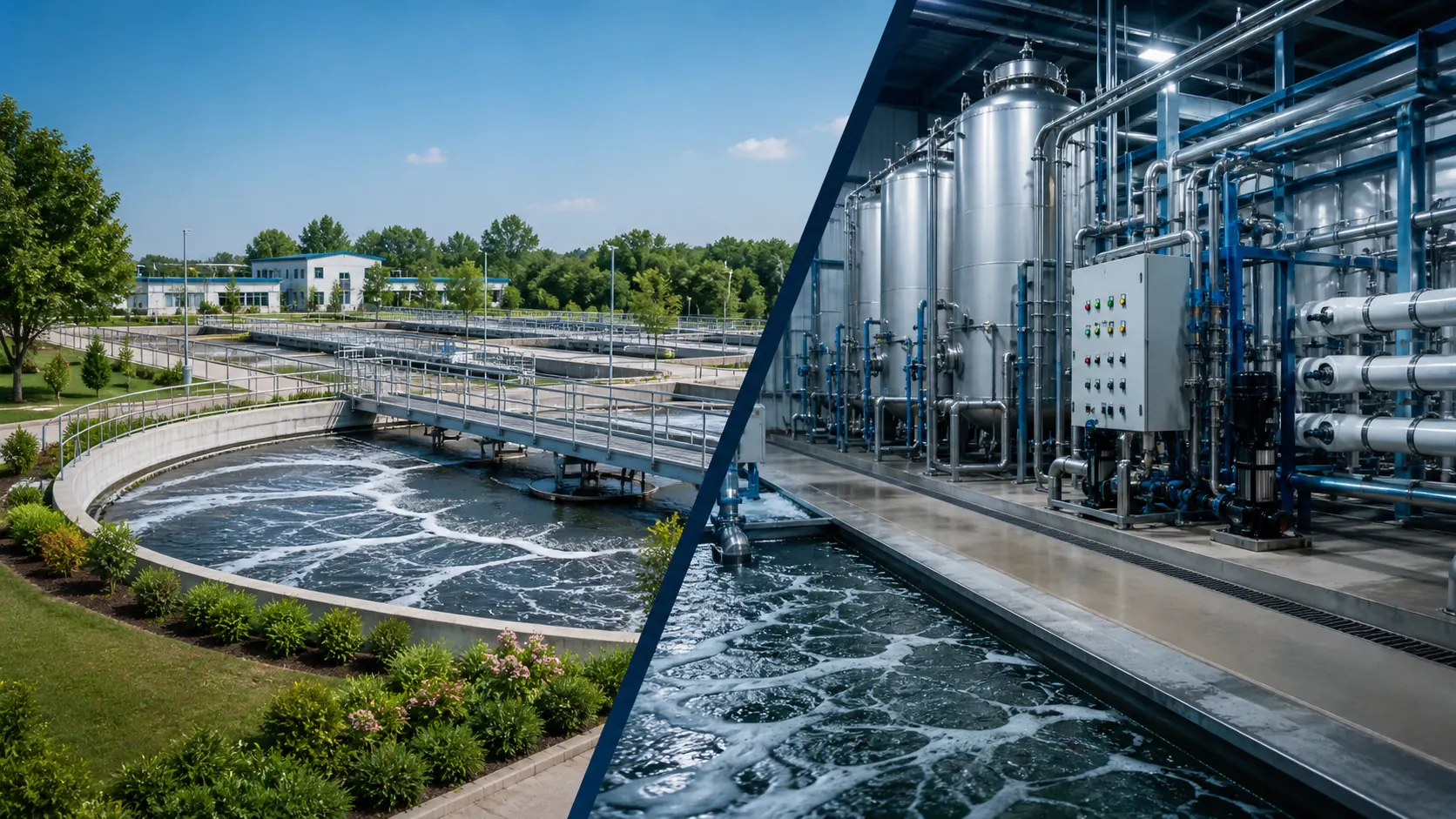
STP and ETP are often discussed as if they are two sizes of the same system. They are not. A sewage treatment plant handles wastewater generated mainly from toilets, washrooms, kitchens and domestic activities. An effluent treatment plant handles wastewater from industrial processes. The sources, pollutants, variability, risks and treatment objectives can be very different, so the plant must be designed from actual water-quality data and intended outcomes.
What an STP is designed to treat
Sewage typically contains organic matter, suspended solids, nutrients, pathogens, soaps and household contaminants. Although its strength varies, the broad treatment challenge is predictable. An STP normally combines screening and equalisation with biological treatment, clarification or membrane separation, disinfection and sludge handling. Common biological approaches include activated sludge, MBBR, SBR and membrane-based systems.
Technology selection depends on flow pattern, land, power, operator capability, reuse target and discharge requirements. A hotel, factory township, hospital campus and office complex may generate similar categories of sewage but at different daily patterns. Peak flow and low-flow periods matter because biological systems need stable conditions to perform well.
What makes an ETP different
Industrial effluent comes directly from manufacturing, processing, cleaning, laboratories or utilities. Its characteristics depend on raw materials and production. It may contain high organic load, oils, metals, salts, colour, solvents, acids, alkalis or compounds that inhibit biological treatment. Two factories with the same employee count can therefore need completely different ETPs.
An ETP may use segregation, equalisation, pH correction, coagulation, flocculation, clarification, oxidation, biological treatment, filtration, membranes, evaporation or other specialised processes. The treatment train should be selected after representative sampling and, for complex effluent, treatability testing. A generic package plant chosen only by litres per day can fail even when its nominal capacity looks adequate.
Source segregation improves both systems
Domestic sewage and industrial effluent should be mapped before pipes are connected. Mixing a concentrated process stream into sewage can upset an STP, increase sludge and make reuse difficult. Sending relatively clean cooling-water blowdown or stormwater into an ETP can unnecessarily increase hydraulic load and operating cost. Segregation allows each stream to receive the treatment it actually needs.
Map every wastewater source, quantity, schedule and expected quality. Identify batch discharges, cleaning cycles and seasonal production changes. Separate uncontaminated rainwater from wastewater networks. Good drainage architecture can reduce capital cost, improve treatment stability and prevent accidental discharge more effectively than adding equipment later.
Define the required output before choosing technology
The treatment target is shaped by applicable consent conditions and the proposed destination. Water intended for gardening, toilet flushing, cooling, process reuse or discharge may require different polishing and disinfection. Reverse osmosis is not automatically the final answer; it can improve dissolved-solids quality but also creates a reject stream that needs responsible management.
Start with an inlet and outlet quality matrix. Include average and peak flow, key contaminants, desired reuse quantity and limits. Then compare alternatives for reliability, recovery, energy, chemicals, sludge, reject, footprint and operator needs. The best plant is not the one with the longest equipment list, but the one that consistently meets the target under real operating conditions.
Operations determine performance
Both STPs and ETPs need trained attention. Operators must understand flow balancing, dosing, aeration, membrane cleaning, sludge removal, alarms and sampling. Preventive maintenance and critical spares reduce downtime. Laboratory testing should confirm performance at appropriate stages, not only at the final outlet after a problem appears.
Automation can improve consistency, but it does not eliminate process ownership. Online readings should be checked against calibration and laboratory results. Odour, colour, foam, pressure, energy use and sludge characteristics often provide early warning. A clear logbook and escalation procedure help operators respond before quality drifts beyond the required limit.
Use a structured selection process
Before procurement, complete a wastewater survey, representative laboratory analysis and flow assessment. Confirm space, access, power, ventilation, chemical storage, sludge handling and future expansion. Ask bidders to state design assumptions and guaranteed inlet and outlet conditions. Compare lifecycle cost, not only equipment price, because electricity, chemicals, membranes, manpower and disposal continue for years.
If a site produces both sewage and process effluent, it may need separate STP and ETP systems with carefully planned opportunities for combined polishing or reuse. The right arrangement is site-specific. Strong engineering turns wastewater from a compliance burden into a managed resource that can reduce freshwater demand without compromising safety or reliability.
Questions to ask a treatment partner
Ask which samples and flow data informed the design, how the plant handles peak and low loads, what happens to sludge and reject, and which instruments protect output quality. Request expected power, chemical and consumable use per kilolitre. These answers reveal whether the proposal is grounded in operations or only in equipment capacity.
Key takeaways
- STPs treat domestic sewage; ETPs treat process-specific industrial effluent.
- Sample actual wastewater before selecting technology.
- Segregate streams to protect performance and control cost.
- Evaluate reuse, residuals and lifecycle operation together.