
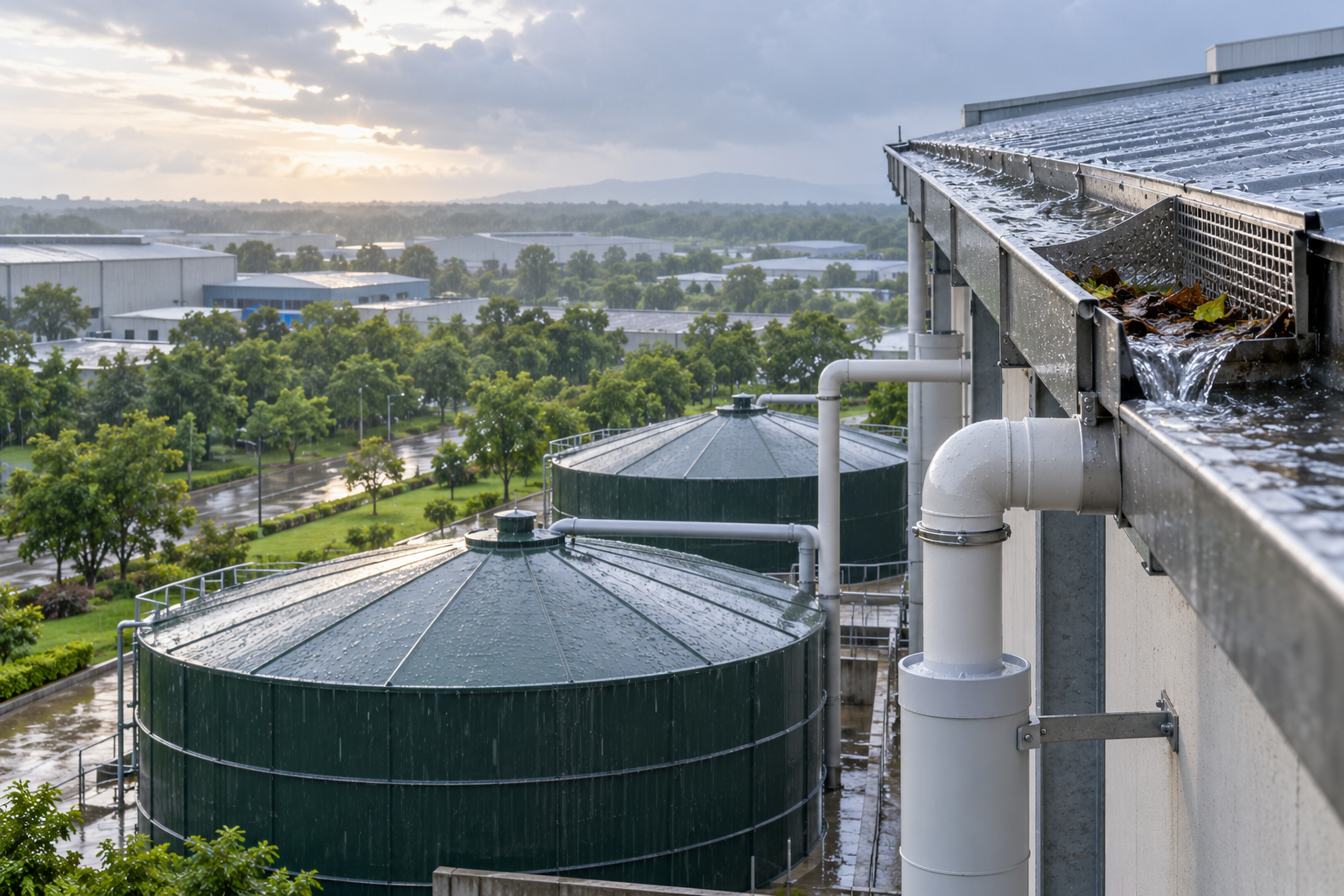
A factory roof can capture a useful water resource, but annual rainfall is only the beginning of the design. Water must arrive when there is demand, pass through suitable collection and treatment, and reach storage or a scientifically assessed recharge structure. For Maharashtra industries managing shortages, rainwater harvesting can reduce pressure on shared municipal supplies and support groundwater management. This guide explains the calculations, design choices and operating checks that turn potential into measured, useful water.
“Periodic maintenance of artificial recharge structures are essential”
Central Ground Water Board, Manual on Artificial Recharge of Ground Water
Why harvesting matters during a supply constraint
Maharashtra has announced minimum 10% reductions in local-body water supply beginning 16 October 2026, while prioritising drinking water and calling for conservation and reuse. Rainwater captured on a factory roof or other suitable catchment can offset a portion of non-potable demand—such as landscape irrigation, toilet flushing, selected cleaning or cooling makeup after treatment and technical approval. Each kilolitre safely substituted is one less kilolitre that the site needs from another source at that time.
Timing matters. October is after the main monsoon for many locations, so a new system installed now may not provide immediate relief unless there is stored water or further rainfall. The strongest preparation is to assess and commission before the next rainy season, while managing current demand and wastewater reuse in the meantime.
References: News on AIR: Maharashtra orders 10% water cut from October 16
Estimate potential without overpromising
For initial screening, collected volume in kL = rainfall in mm × catchment plan area in m² × runoff coefficient ÷ 1,000. One millimetre over one square metre is one litre before losses. Use a coefficient appropriate to the surface and document its basis. Apply first-flush and conveyance losses separately only if they are not already included; avoid counting the same loss twice.
Illustrative example: a surveyed 5,000 m² roof receiving 800 mm/year at an assumed coefficient of 0.8 gives 3,200 kL/year before additional separately modelled losses. An illustrative further 10% loss leaves 2,880 kL. Neither 800 mm nor 0.8 is a default for Maharashtra. Use local data and engineering assumptions. Water that reaches storage may still overflow or have no matching demand, so this is potential collection rather than guaranteed substitution.
| Input or result | Value | Meaning |
|---|---|---|
| Eligible roof plan area | 5,000 m² | Surveyed usable catchment |
| Annual rainfall | 800 mm | Example, not a local rainfall claim |
| Runoff coefficient | 0.8 | Assumed surface response |
| Gross estimate | 3,200 kL/year | 800 × 5,000 × 0.8 ÷ 1,000 |
| After further assumed 10% loss | 2,880 kL/year | Potential entering storage, not guaranteed useful yield |
Use local rainfall distribution and lower-rainfall scenarios
IMD publishes district and other rainfall products and provides access to historical data services. Choose a record representative of the site and retain the station or spatial basis and period. District totals support screening; detailed drainage design needs appropriate rainfall intensity and duration, not simply an annual normal.
A coastal location, a western hill site and an eastern industrial estate should not inherit one yield assumption. Compare several historical years, including lower-rainfall conditions and long dry spells. Present a range of usable yield. Also map non-potable demand by month: irrigation can fall during the monsoon just as collection increases, so a project reliant mainly on landscaping may substitute less purchased water than its roof potential suggests.
References: India Meteorological Department: Rainfall information and historical-data access
Survey the catchment and keep dirty runoff separate
Map each roof by area, material, slope, drain location and condition. Inspect gutters, downpipes, sumps and maintenance access. Roofs exposed to process emissions, dust, bird activity or chemical handling may need cleaning, separation or additional treatment before water can be considered. Yard runoff may carry oil, metals, sediment or other contaminants and should not be routed into a clean-water system without a suitable assessment.
Install screens and accessible silt traps, and divert the initial runoff after a dry period through a first-flush arrangement designed for the site. Provide a safe overflow for intense rainfall. Include inspection and cleaning in the operating plan; a blocked or bypassed collection line can make the system appear installed while yielding little usable water.
References: CGWB: Rooftop rainwater harvesting, first flush and filtration
Match storage to demand, season and space
A storage tank should be sized by comparing the expected timing and volume of inflow with the facility’s non-potable demand and available footprint. Large storage can capture more water but costs space and capital; small storage can overflow during early storms. The best design may combine tanks for short-term reuse with a safe overflow path to suitable recharge infrastructure or another approved destination.
Protect storage from debris, sunlight where relevant, pests and accidental contamination. Provide covers, level indication, access for cleaning, pumps, isolation valves, backflow prevention and clearly marked non-potable piping. Keep water-quality testing and treatment requirements linked to the specific application, not just the tank outlet.
Size rainwater storage with a daily water balance
Model opening storage, captured inflow, approved withdrawal, overflow and losses for each day, starting with the previous day's closing volume. An initial daily model can assume inflow arrives before demand: overflow = max(0, opening storage + inflow − tank capacity); usable withdrawal = min(demand, min(capacity, opening storage + inflow)); closing storage is the remaining volume after use and other losses. Refine timing to hourly steps if rainfall and demand vary strongly within a day.
Repeat the model for candidate tank sizes and several rainfall years. Compare extra useful water from each storage increment with its cost. A larger tank helps only if it captures water that would otherwise overflow and there is later demand to use it. It does not create rainfall or remove quality limits.
Illustrative dry-spell check: 25 kL/day of approved demand for 30 rainless days needs 750 kL of usable storage with no other inflow. A usable 200 kL reserve covers eight days. This explains why annual collection potential can look substantial while a small tank cannot provide prolonged dry-season independence.
Check storm conveyance and safe overflow capacity
Annual collection yield does not size gutters and pipes. For a preliminary roof check, runoff Q in litres/second = coefficient × rainfall intensity in mm/hour × area in m² ÷ 3,600. An illustrative 2,000 m² roof at 100 mm/hour and coefficient 0.9 produces 50 L/second. That intensity is an assumed example, not the specified design storm for your location.
A qualified designer must check actual design intensity, gradients, outlets, blockage allowance, structural loads and overflow routes. Fine screens can clog and cause roof waterlogging. Provide accessible inspection and bypass arrangements, keep rainwater out of inappropriate effluent networks and protect production areas when tanks are full. Collection efficiency and flood-safe drainage are related but separate design objectives.
Choose uses by quality—not by convenience
A source-to-use table should show raw-water quality, treatment, required quality, monitoring and the point of use. Garden irrigation, toilet flushing and some washdown may be options after appropriate checks. Cooling or process uses may need more consistent water quality and additional treatment to prevent scaling, corrosion, fouling or product risk. Do not connect harvested water to drinking or food-contact uses without the required treatment and approvals.
Separate non-potable networks from potable supply, label outlets and train operators. If water does not meet its target, isolate it and send it for retreatment or safe disposal. The objective is dependable substitution without transferring a water-shortage problem into equipment damage, worker exposure or contamination.
References: US EPA WaterSense: Onsite alternative water sources; US EPA WaterSense: Water quality considerations, May 2025
Recharge surplus only when the site supports it
Groundwater recharge may be a valuable destination for suitable surplus, but it is not a universal default. Assess geology, soil permeability, groundwater depth and quality, nearby wells, contamination risks, foundation setbacks and local requirements. Use pretreatment and accessible inspection chambers. A poorly located recharge structure can clog, cause waterlogging or introduce contaminants into groundwater.
Where the site is not suitable, prioritise storage and safe reuse, improve an existing system, or consider a scientifically planned watershed or community intervention. Recharge outcomes need appropriate baselines and monitoring; a constructed pit alone is not proof of groundwater replenishment.
GSDA describes the Pune region as predominantly hard rock, with basalt a major formation and variable groundwater conditions. This is regional geological context, not a current assessment for an individual site. Weathering, fractures, slopes and seasonal groundwater levels affect recharge performance. A deeper pit or well is not automatically better. Never use a recharge route to dispose of untreated industrial effluent or polluted yard runoff.
| Option | Useful when | Key limitation |
|---|---|---|
| Storage and reuse | Suitable demand and storage space exist | Finite buffer; treatment and seasonal modelling required |
| Groundwater recharge | Assessed geology and water quality permit it | No guaranteed later recovery at a particular borewell |
| Hybrid | Both immediate demand and surplus recharge are suitable | Needs coordinated controls and separate records |
References: CGWB: Manual on Artificial Recharge of Ground Water; Maharashtra GSDA: Pune region geology and groundwater context
Operate, meter and improve the system
Assign responsibility for pre-monsoon roof cleaning, filter checks, desilting, pump maintenance, water-quality tests and post-storm inspections. Record volume captured, volume reused, overflow and maintenance. Compare actual performance with the design estimate after each season and correct blocked drains, poor demand matching or inadequate storage before the next monsoon.
Maharashtra’s State Water Policy calls for industrial water-footprint reduction and annual water reporting for qualifying high-volume industrial users, including quantities of harvested rainwater used, recycled water and fresh water. Facilities should check current reporting applicability and capture reliable meter data. A measured rainwater contribution is more credible—and more useful for future investment—than a claim based only on tank capacity.
At commissioning, demonstrate valves, diversion, pumps, isolation and safe overflow, and hand over a labelled flow layout. A rise in nearby well levels alone does not prove that one recharge structure caused it; rainfall, pumping and surrounding activity also matter. Investigate unexpectedly high overflow, bypassed filters or blocked channels against design assumptions.
References: Maharashtra State Water Policy 2019; CGWB: Manual on Artificial Recharge of Ground Water
Build the business case from usable substitution
Calculate annual net saving from useful water replacing the relevant source, less recurring pumping, treatment, testing, cleaning and maintenance. Include civil works, collection pipes, filtration, controls, electrical work, structural provisions and commissioning in capital cost. Use site quotations rather than generic price promises.
Illustrative calculation: 1,800 kL/year useful substitution at ₹120/kL avoided delivered-water cost gives ₹2.16 lakh/year gross avoided cost. With ₹0.60 lakh recurring costs, net saving is ₹1.56 lakh/year. A ₹9 lakh investment has simple payback of about 5.8 years. These are hypothetical inputs, not SWR project prices or reported results. Test lower rainfall, lower utilisation and replacement costs separately.
Keep flood-management, recharge and CSR or ESG outcomes separate from cash savings unless a documented valuation supports them. Collection, reuse, recharge-directed flow and municipal substitution are different metrics. For CSR water projects, include operator ownership, maintenance funding and beneficiary evidence alongside construction milestones.
Make harvesting one part of a stronger water plan
Rainwater harvesting is a strong, decentralised way to capture seasonal water, reduce suitable non-potable demand and potentially support recharge. It is not automatically the single best intervention for every site. A facility with little clean catchment or no storage may gain more immediately from leak repair, process efficiency or treated wastewater reuse; another may benefit from integrating all of them.
The durable approach is a portfolio: reduce avoidable demand, reuse fit-for-purpose treated water, capture and store rain where feasible, recharge responsibly and protect essential municipal supplies for people and services that depend on them. A site-specific water balance can show which combination offers the most reliable value.
Frequently asked questions
Can rainwater harvesting eliminate municipal water dependence?
It can reduce dependence when rainfall, eligible catchment, storage, treatment and demand align. Complete independence must be demonstrated with seasonal water-balance modelling, including lower-rainfall years and dry spells.
What is the difference between rainwater storage and groundwater recharge?
Storage retains water in a tank for controlled use. Recharge moves suitable water into a scientifically assessed aquifer system. Recharge volume is not a guarantee of later recoverable supply at a particular borewell.
How much rainwater can a factory roof collect?
A screening estimate in kilolitres is rainfall in millimetres multiplied by catchment area in square metres and runoff coefficient, divided by 1,000. Account for collection losses, overflow and matching demand to estimate useful substitution.
When should a Maharashtra factory start a rainwater harvesting project?
Start early enough to complete surveys, design, approvals, procurement and commissioning before the main rainy season. During current restrictions, combine this preparation with immediate efficiency measures and validated reuse or backup supply.
Key takeaways
- Size collection from local rainfall, suitable catchment and real demand.
- Treat and test water for its intended use.
- Do not count unsaved or uncollected monsoon water as dry-season supply.
- Use groundwater recharge only after site and water-quality assessment.
Free tools for this topic
Related SWR guides and services
Sources and further reading
Calculation examples are illustrative planning calculations, not reported project results. Confirm current Indian and site-specific requirements before applying international guidance.
- News on AIR: Maharashtra orders 10% water cut from October 16
- Maharashtra Water Resources Regulatory Authority: Promoting Water Conservation
- Maharashtra State Water Policy 2019
- Central Ground Water Authority: Guidelines for groundwater extraction
- India Meteorological Department: Rainfall information and historical-data access
- CGWB: Manual on Artificial Recharge of Ground Water
- CGWB: Rooftop rainwater harvesting, first flush and filtration
- Maharashtra GSDA: Pune region geology and groundwater context
- US EPA WaterSense: Onsite alternative water sources
- US EPA WaterSense: Water quality considerations, May 2025