
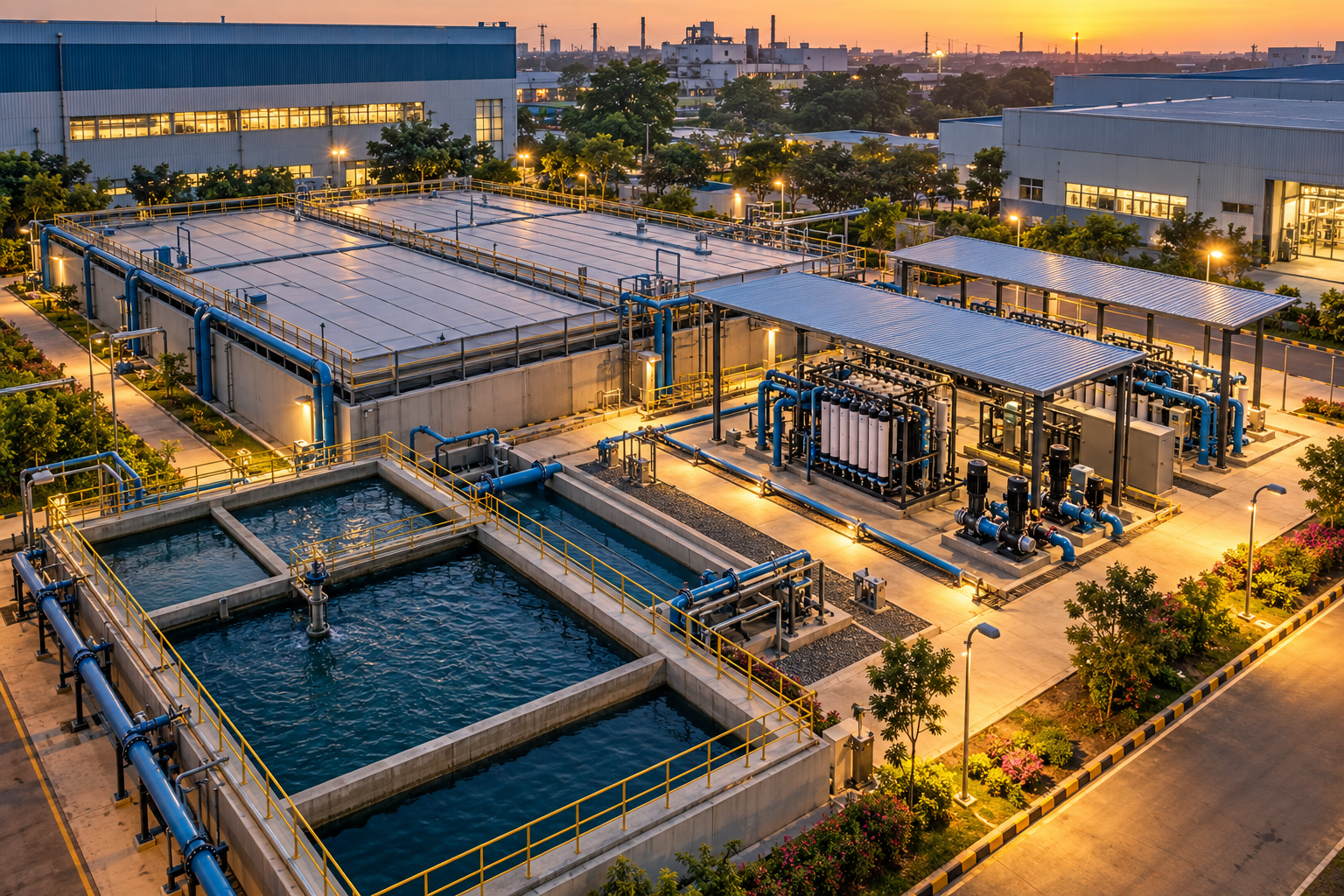
An industrial water continuity plan should answer a practical question: if dependable supply falls tomorrow, how long can the facility maintain safe operations, and what happens next? Extra tanks and a tanker contact are useful only when suitable water can reach the right operation at the required rate. This guide takes the Maharashtra water-shortage response beyond immediate repairs into a plan that leadership, procurement, quality and utility teams can test. The calculation examples show methods, not actual plant results, and should be replaced with measured site data.
“All industrial units must endeavour to reduce their water footprint”
Maharashtra State Water Policy 2019
Treat water as a continuity risk, not a facilities-only issue
Water interruptions can affect utilities, cooling, cleaning, product formulation, sanitation, contractors and dispatch. Bring production, engineering, EHS, quality, procurement, finance and leadership into one risk review. Map each operation’s minimum water quantity and required quality, then identify the consequence and recovery time if that supply is reduced.
Use actual evidence: monthly bills, inlet and sub-meter readings, tanker records, well levels where relevant, process recipes, treatment logs, consent conditions and supply notices. Identify data gaps explicitly. A continuity plan built on assumed daily demand may overstate spare capacity or overlook a single high-use process.
Assess volume, quality, timing, pressure and access together. Fewer supply hours can create a receiving or transfer bottleneck even when daily volume is adequate. Map minimum demand for cooling, boilers, sanitation, environmental controls and safe shutdown. Leadership should know whether the plan protects full output, an agreed reduced-output mode or a controlled stop before a utility becomes unsafe.
References: News on AIR: Maharashtra orders 10% water cut from October 16
Set triggers and decision rights before a shortage
Agree simple triggers tied to observable conditions: a formal local-body notice, a percentage reduction at the main meter, storage below a critical level, a treatment plant outage or a supplier delivery delay. For every trigger, name the decision-maker, required checks, communications and next action. Define who can authorise a temporary production change or activate a contracted backup source.
Run scenarios for a 10% reduction, a multi-day interruption and a longer dry-period constraint. Those are planning scenarios, not forecasts. Estimate how long storage lasts under each case, identify the uses that can be shifted or supplied from another source, and document what has to stop if the limit is exceeded. Review the scenarios with safety and quality teams before an incident.
Define approved operating modes before tanks run low
Work backwards from essential safety, hygiene, environmental and equipment requirements. Separate them from production demand that may move between shifts and uses that can be deferred. Obtain production and quality approval for each mode. A wash or cooling duty is not discretionary merely because it sits outside the main production line. Dedicated fire-water reserves remain outside normal production storage.
The following framework needs actual site quantities and named decision-makers. Write the trigger, response and recovery condition for each mode. Keep a short shift-level operating sheet supported by the detailed calculations.
| Mode | Objective | Decision |
|---|---|---|
| Normal | Maintain output while meeting reduction targets | Daily balance, approved reuse and loss closure |
| Restricted | Run agreed output with limited supply | Source allocation, shift mix and quality approval |
| Critical | Protect people, equipment and environmental controls | Controlled curtailment or shutdown authority |
| Recovery | Restart after stable supply and quality | Inspection, quality release and staged startup |
Create a fit-for-purpose source portfolio
List available sources and their constraints: municipal water, MIDC or industrial-estate supply, groundwater subject to permission, tankers, captured rainwater and treated wastewater. For each, record volume reliability, seasonal availability, quality range, cost, delivery lead time, storage needs, permissions and dependencies. A source is not dependable merely because it exists on a drawing or was available last year.
Avoid relying on one emergency tanker contract as the entire contingency. Confirm approved suppliers, vehicle access, delivery capacity, water-quality documentation, receiving/storage capacity and procurement authority. Review any regulatory, groundwater or discharge requirements with the relevant authority or qualified adviser before changing abstraction or discharge practices.
Classify sources as demonstrated, contracted but untested, or only proposed. Two suppliers drawing from the same reservoir or aquifer are not fully independent. Map shared power, roads and treatment dependencies. For tankers, verify source documentation, unloading time, receiving capacity, acceptance testing and rejection criteria. Count delivery cycles realistically. Stored rainwater may be available now; future rain is not guaranteed dry-period supply.
Calculate usable storage and supply autonomy
Nameplate tank volume is not all available working water. Deduct dead storage, dedicated reserves, isolation requirements and water unsuitable for critical uses. Confirm level instruments, transfer pumps and connecting pipe capacity. Two tanks are not one working reserve if their interconnection cannot serve essential loads.
For approximately steady conditions, autonomy in days = usable working storage ÷ daily shortfall. Shortfall is restricted-mode demand minus dependable inflow. Illustrative example: demand of 160 kL/day and dependable inflow of 120 kL/day leave a 40 kL/day deficit. A usable 240 kL reserve supports that deficit for about six days. If inflow stops entirely, the same reserve covers only 240 ÷ 160 = 1.5 days. Show both scenarios.
Use hourly steps when supply is intermittent or demand peaks sharply. Set escalation early enough to cover approval, ordering, delivery, treatment and transfer lead time. Even with no average shortfall, a facility may need storage for interruption or quality events; a daily-average calculation does not eliminate those risks.
Convert treatment capacity into dependable reusable water
STP or ETP rated capacity is not the quantity of usable water delivered daily. Start with actual wastewater generation, treatable streams, quality-approved recovery, downtime and matching demand. Treatment must fit contaminants and variability; sewage and process effluent should be characterised separately.
A preliminary average-volume calculation is feed × usable recovery × availability, limited by compatible demand. Illustrative inputs of 100 kL/day feed, 80% usable recovery and 90% availability give 72 kL/day average output. If approved applications accept only 50 kL/day, freshwater substitution is capped at 50. The average does not prove outage resilience: model days when the plant produces nothing.
Include membrane reject, backwash, sludge and off-spec water in the design and consent review. A plant producing reusable output also needs a responsible route for residuals. Sample representative conditions rather than only the easiest operating day.
References: National Productivity Council: Water Audit; US EPA WaterSense: Onsite alternative water sources
Set water-quality acceptance and diversion controls
Record who samples, where, how often and against which approved application-specific limits. Salinity may constrain cooling or irrigation; microbial and product-contact risks matter elsewhere. Clear-looking water is not proof of suitability. Give operators authority and a defined route to isolate or divert off-spec water.
Storage changes water conditions. Review turnover, stagnation, cleaning access, temperature and treatment or disinfection as appropriate. Keep potable and non-potable networks separate. A satisfactory commissioning sample cannot replace continuing quality control.
| Field | Record |
|---|---|
| Source and destination | Recovered stream and approved use |
| Acceptance limits | Parameter-specific limits and current applicable conditions |
| Monitoring | Sampling location, frequency, owner and instrument checks |
| Failure response | Isolation, diversion, alternative supply and investigation |
| Restart | Evidence required and release authority |
References: US EPA WaterSense: Water quality considerations, May 2025
Reduce demand and reuse water inside the fence
The lowest-risk supply is often demand that no longer needs to be met. Repair leaks, meter high-volume branches, eliminate unnecessary continuous flows and review rinse and wash cycles with process owners. Cooling systems may offer recirculation or blowdown optimisation opportunities, while condensate and suitable treated effluent may serve selected uses after quality evaluation. Every intervention needs a measured baseline and verification that product, equipment and worker-safety requirements remain satisfied.
The National Productivity Council recommends a water balance and specifically calls attention to monitoring, leaks, treatment and reuse opportunities. Maharashtra’s 2019 State Water Policy encourages industrial process optimisation, wastewater recycling and reuse; it also describes annual water reporting for industrial users consuming at least one million cubic metres per year. Check current applicability and the facility’s obligations before treating any policy provision as a site-specific compliance determination.
References: Maharashtra State Water Policy 2019; National Productivity Council: Water Audit
Design treatment and storage for real operating conditions
Alternative water needs treatment matched to end use, not a one-size-fits-all plant. Define the raw-water range, required outlet quality, peak flow, variability, reject or sludge management, monitoring, maintenance and operator responsibilities. Identify a safe diversion route when the treated water is off specification. Keep potable and non-potable systems clearly separated and prevent accidental cross-connections.
Size storage from dependable inflow, required buffer, consumption profile, delivery lead time and space. Include inspection access, covered tanks, overflow, level indication and cleaning arrangements. A tank is not useful continuity capacity if it cannot be filled, treated, isolated or safely connected when needed.
References: US EPA WaterSense: Water quality considerations, May 2025
Prepare people, suppliers and records
Write concise operating procedures for normal, restricted and recovery modes. Include who checks the main meter and storage, how operators report leaks or quality issues, who contacts suppliers and authorities, and how changes are logged. Train shift leaders and contractors; a plan that only the sustainability manager knows is not an operating control.
Keep source approvals, test reports, meter calibration, supply contracts, maintenance records, water-balance updates and incident decisions in one controlled location. After a drill or actual restriction, record what worked, where demand estimates were wrong and how long each action took. Use those lessons to update the plan.
Compare total delivered-water cost and payback
Compare alternatives per kilolitre of compliant water at the point of use. Include raw purchase, transport, pumping, treatment, chemicals, monitoring, residual management, maintenance and operator costs. Keep capital and recurring costs visible. Cheap raw water may become expensive after treatment; a costlier source may still be useful during a short emergency.
Simple payback = initial investment ÷ annual net operating saving. Illustrative example: ₹12 lakh investment and ₹3 lakh/year net saving give four years. This is arithmetic, not a quotation or discounted appraisal. Test lower utilisation, energy costs and replacement needs. Assess avoided downtime separately with finance-approved assumptions rather than treating speculative lost production as guaranteed savings.
A 90-day preparation sequence
Days 1–30: verify the baseline, local restrictions, critical uses and supply contacts. Days 31–60: fix visible losses, measure major consumers, test low-risk operating changes and confirm alternative-source quality and capacity. Days 61–90: complete a scenario drill, sign off decision rights, close treatment or storage gaps and set a quarterly review. Adjust the schedule to the site’s procurement, safety and regulatory requirements.
Preparedness should improve ordinary efficiency as well as emergency response. When the next restriction arrives, the facility should already know which actions are safe, which source can serve which demand, and how management will protect essential operations without shifting avoidable pressure to neighbouring communities.
Use a tabletop drill for combined failures: municipal inflow falls, the reuse plant stops and a tanker is delayed. Have shift leaders calculate remaining autonomy, select the approved operating mode and make escalation calls. Record missing valves, stale contacts and procurement delays. Any live isolation or shutdown trial must follow site engineering and safety procedures. Review the plan after product-mix, supplier or water-quality changes.
Frequently asked questions
How many days of industrial water storage are needed?
There is no universal number. Use restricted-mode demand, dependable inflow, delivery lead time, outage duration and quality-approved working volume. Model partial supply and zero inflow, and keep dedicated reserves outside normal operating storage.
Can an existing STP or ETP solve a municipal water shortage?
It may replace part of demand if actual output consistently meets an approved use. Check wastewater availability, usable recovery, downtime, residual disposal and matching demand. Rated treatment capacity alone is insufficient.
Should industries rely mainly on tankers during restrictions?
Tankers need source, quality, delivery and receiving checks. Combine verified demand reduction, suitable reuse, usable storage and diversified supply so one delivery failure does not determine the entire response.
Key takeaways
- Map water dependency to production, quality, safety and recovery time.
- Use operational triggers and clear decision rights.
- Validate availability, permissions and quality before counting a backup source.
- Measure water reuse and demand reductions rather than relying on estimates.
Free tools for this topic
Related SWR guides and services
Sources and further reading
Calculation examples are illustrative planning calculations, not reported project results. Confirm current Indian and site-specific requirements before applying international guidance.
- News on AIR: Maharashtra orders 10% water cut from October 16
- Maharashtra State Water Policy 2019
- National Productivity Council: Water Audit
- PIB: Revised groundwater extraction guidelines and water audits
- US EPA WaterSense: Onsite alternative water sources
- US EPA WaterSense: Water quality considerations, May 2025